Chore Credits.
A household agreement children can help shape.
Children choose useful work from a shared menu. Credits describe agreed effort, while parents set boundaries and review exceptions.
 Chore Credits / Early access
Why it exists
The daily chore argument is often about who chooses, what counts and whether the agreement feels fair. Most chore software gives parents better assignment tools. This project asks what changes when a child chooses how to contribute.
An early prototype was a physical board for the wall or fridge. The app grew around it as the private record of eligibility, claims, review and the weekly agreement.
The idea
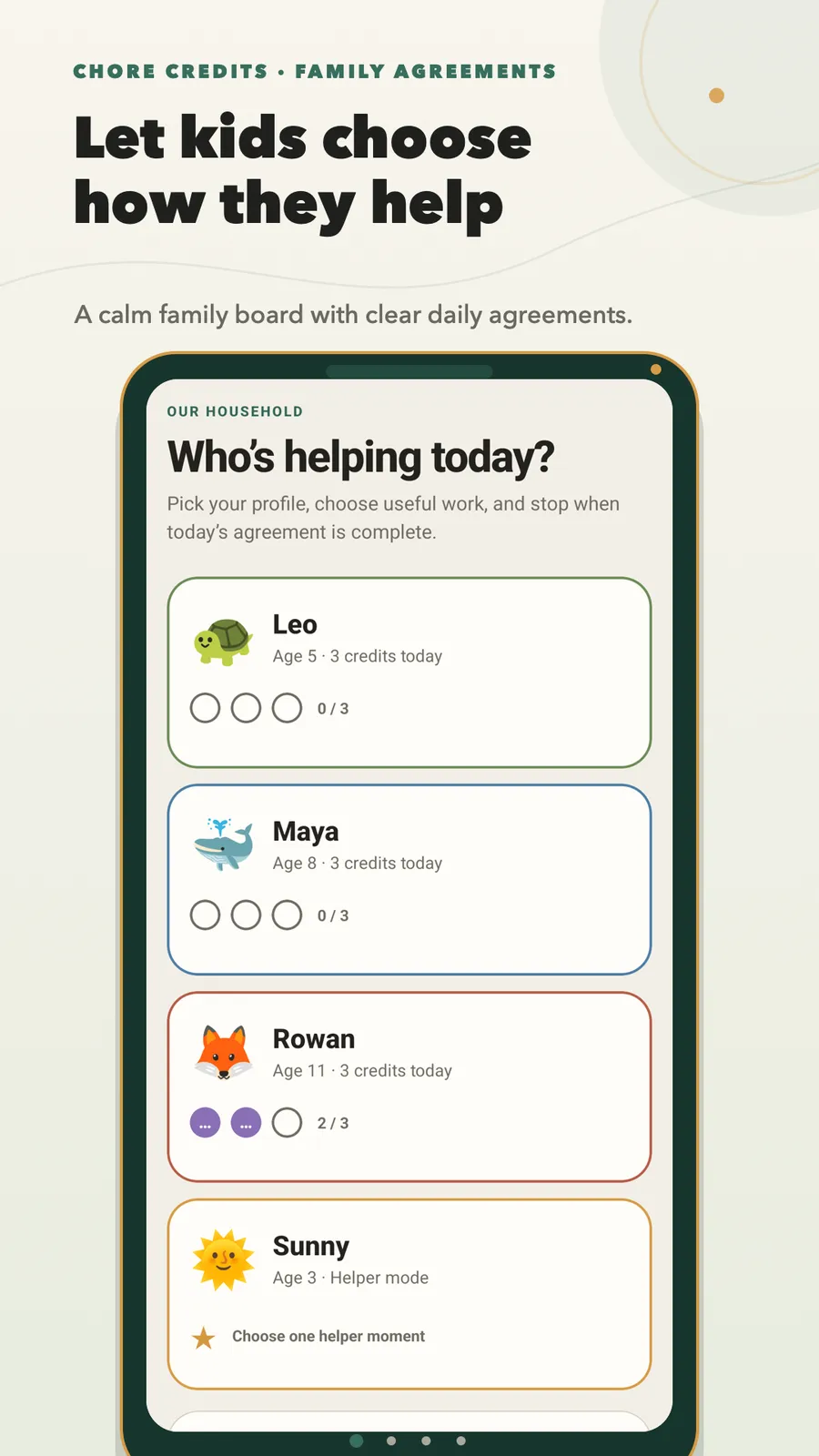
A parent defines chores with bounded one, two or three credit levels. A child sees work available to them and chooses. Submitted work stays visibly separate from approved work, and only approved credits enter the allowance calculation.
Fairness is not identical work for every child. The rules account for age, supervision, exclusive claims and excused days without publishing a sibling ranking.
Experience
The shared board opens into a child's available work. They can claim a chore, see its concrete finish line and submit it. Routine work may approve automatically; exceptions go to a parent review. A printable companion keeps the agreement visible when the device is away.
What I built
I built a local first Android prototype with an SQLite domain model, transactional claims, a parent gate, household history, export and a print ready companion board. It collects a child's birth month and year rather than an exact birthdate.
How it evolved
A physical companion board made the agreement visible in the home.
The local MVP established choice, claims, approval and weekly settlement as one complete loop.
The broader beta work added accessibility controls, history and more precise household rules.
Current state
The Android build is in closed testing. The central question remains whether children use the board independently and whether the agreement reduces daily parent management.